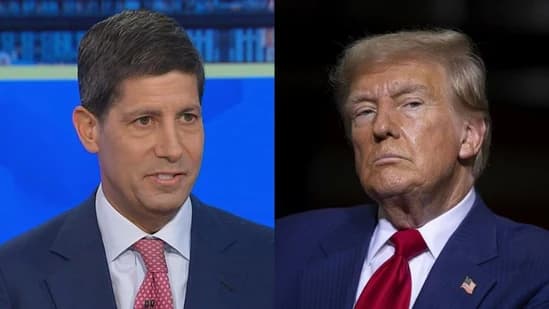
President Donald Trump's nomination to lead the US Federal Reserve would clear a cloud of uncertainty that has hung over markets for months, providing investors with a signal of how monetary policy may evolve once Jerome Powell's term expires in May. Trump announced on Thursday that he would nominate Powell's successor on Friday, with all eyes on former Fed Governor Kevin Warsh. According to Bloomberg News, Warsh will be appointed, and a source close to the situation informed Reuters that Warsh met with Trump at the White House on Thursday.
According to two persons familiar with the situation, President Donald Trump is expected to announce his intention to nominate Kevin Warsh as the next Federal Reserve chairman on Friday. Trump, who had been debating the issue for months and had limited the field to four in recent weeks, informed reporters on Thursday night that he had made his decision and would formally announce it on Friday.
"I'm going to be announcing, I think, a really great choice tomorrow," Trump remarked as he arrived at the documentary screening of first lady Melania Trump. Trump did not reveal his choice. Trump rapidly soured on Powell during his first term, and he has constantly attacked and insulted the chair and the Fed throughout his second term.
Why This News Matters:
President Trump's choice of a new Federal Reserve chair could have a big effect on U.S. monetary policy and the financial markets. Kevin Warsh, a hawkish candidate with a history at the Fed, would probably mean that the Fed is going to be more aggressive with interest rates and monetary policy. This nomination could end the uncertainty that has been hanging over the markets for months, giving investors a better idea of how the Fed will deal with future economic problems. Powell's term ends in May. Warsh's possible plan to cut the Fed's balance sheet and lower rates could make the market react as investors get used to the changes in policy that are likely to happen.
Kevin Warsh as the Likely Nominee
Market participants have been playing out scenarios for months, with Warsh being one of the more hawkish candidates. "If the nominee is indeed Warsh, we could actually end up with a Fed that tilts hawkish at the margin," said Sonu Varghese, global macro strategist at Carson Group in Chicago. Warsh had long been considered as one of Trump's top prospects for the position, and he met with Trump in December for a formal interview. Trump's aides viewed the meeting positively, and Trump informed acquaintances that Warsh performed admirably.
Warsh, National Economic Council Director Kevin Hassett, BlackRock CEO Rick Rieder, and Federal Reserve Governor Christopher Waller were the final four candidates being considered. Trump conducted in-person interviews with each of the final four contenders, marking the end of a process that completed earlier this month. Warsh served as a Federal Reserve governor for five years after being nominated by President George W. Bush. He was considered for important economic positions in both the first and second Trump administrations, including Treasury Secretary, before Trump chose Scott Bessent. In 2017, Trump considered Warsh for the Fed head position, which eventually went to Jerome Powell.
Market Reactions to Warsh's Potential Nomination
Warsh "is on record as saying he prefers lower rates," said Damien Boey, portfolio strategist at Sydney-based Wilson Asset Management. "But the trade-off for lower rates is that he wants the Fed to have a smaller balance sheet." The markets are reacting as if asking, 'What would the world look like with a lower Fed balance sheet?'"
The dollar's 0.5% gain versus other majors, combined with selling at the long end of the bond market, which steepened the yield curve, reflected speculations that Warsh would be less likely to lower yields via Fed expenditures. "The market just unwound their positions for Rick Rieder, who would flatten the curve," explained Kentaro Hatono, head of global fixed income at Asset Management One in Tokyo. "Instead, the market bet on curve steepening as Warsh would tighten the Fed's balance sheet."
Other Candidates for Fed Chair
The other major candidates for the position have included Fed Governor Christopher Waller and Rick Rieder, BlackRock's chief bond investment manager. Kevin Hassett, the White House economic adviser, was an early contender but is now considered as an improbable choice after Trump stated that he would like to keep him in his current position.
On Thursday night, Trump looked to have made his choice, and plans for a White House statement were in the works, according to the sources. Trump's nominee will be evaluated for his perceived capacity to carry out monetary policy without succumbing to political pressure, a feature that economists say is at the heart of any central bank's inflation-fighting powers and what sustains the financial stability of the US economy.
Kevin Warsh: Background and Personal Life
Kevin Warsh is married to Jane Lauder, the rich heir of the Lauder cosmetics empire. The two got married in 2002. Warsh's wife is Estée Lauder's granddaughter. While Warsh's exact net worth is unknown, he served as a Federal Reserve Governor from 2006 to 2011, earning more than $200,000 per year, totaling $1,200,000. Prior to that, he was a Morgan Stanley executive, attaining to the position of Vice President.
Warsh has previously expressed support for Bitcoin, describing it as a "sustainable store of value, similar to gold." He was born in Albany, New York, and attended Stanford University before going to Harvard Law School. Warsh also holds degrees from Harvard Business School and the Massachusetts Institute of Technology's Sloan School of Management.
Public Statements and Speculation on Warsh's Nomination
"It's going to be somebody that is very respected, somebody that's known to everybody in the financial world," Trump added. "And I think it's going to be a very good choice." Warsh met with Trump at the White House on Thursday, according to a person familiar with the situation, and administration officials have been preparing since then for the former Fed governor to be Trump's choice. The White House and Warsh did not immediately reply to calls for comment.