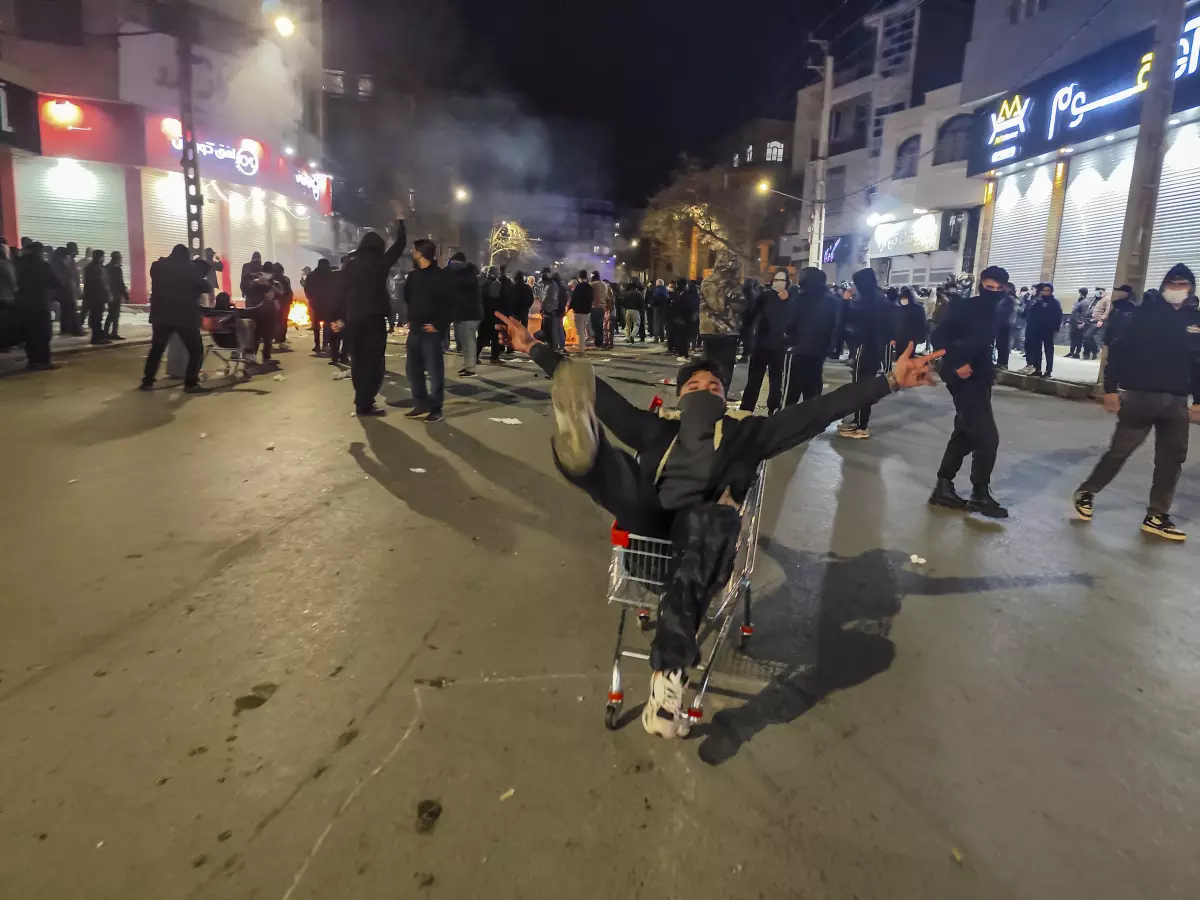
Iran witnessed a nationwide internet blackout on Thursday night (January 8, 2026) escalating the situation in Tehran as mass anti-government protests intensified around the nation, with Iranians shouting slogans against the ruling theocratic regime.
These anti-government protests, angered due to inflated costs of living amid a collapsing economy, comes after twelve days of protests in the country. Authorities immediately blocked internet connectivity and suspended telephone services following Thursday's demonstrations in the capital Tehran and other major cities.
However, the blackout did not immediately obstruct the circulation of videos recording the protests, which are now in their second week. “National blackouts tend to be the regime’s go-to strategy when deadly force is about to get used against protesters,” Alp Toker, director of cybersecurity watchdog NetBlocks, told CNN. “With the goal being to prevent the spread of news of what’s happening on ground, and also to limit international scrutiny.”
Protests have erupted in over 100 cities, spanning from Ilam, a Kurdish-majority region bordering to Iraq, to Tehran and Mashhad in the northeast near the Afghan border, over the past 12 days. Authorities have returned to their regular strategy of enforcement without providing feasible solutions to the concerns fueling public discontent.
“This feels different because it’s about the people’s buying power, and people really can’t afford anything,” said a 30-year-old Tehran resident, as millions of Iranians are struggling with the rampant inflation and a plummeting currency. “Prices keep going up almost hour-by-hour at this point, but how it ends no one really knows ... Everyone feels worried,” he added.
As the death toll increased due to a crackdown by the authorities, human rights groups accused Iranian security forces of shooting at protesters. According to Norway-based Iran Human Rights NGO (IHRNGO), so far at least 45 protestors, including eight children have been killed, while more than 2,260 others have been detained.
According to a video reviewed by CNN, one of the slogans shouted by the protestors was “This is the last battle, Pahlavi will return,” heeding the exiled Crown Prince Reza Pahlavi’s call.
Why This News Matters
The Iran government’s internet blockade and the protests that followed reflect the deteriorating political and economic situation of the nation currently. It also shows the courage of the Iranian citizens who are strongly protesting against the government’s blockades, who resort to crude methods as internet crackdowns rather than providing attainable solutions.
It also briefly shows the exercise of power by foreign nations in situations like this, in this case the U.S., who is threatening action on the theocratic Iranian government if they turn to violence on the Iranian people.
The protests which have been going over for two weeks in more than 100 areas also show that the outburst is not just limited to politics. The high inflation and cost of living have destroyed the economy with people struggling to live and the people are calling for a regime change, encouraging the return of Reza Pahlavi, their exiled Crown Prince.
Pahlavi’s Call
Pahlavi wrote on X to encourage Iranians to "take to the streets and, as a united front, shout your demands" when the most recent protests were going on. He said, "Rise Iran!"
In a post on X, Pahlavi said "millions of Iranians demanded their freedom tonight", describing the protesters as his "courageous compatriots". He expressed gratitude to US President Donald Trump for holding the "regime to account" and urged European leaders to follow suit.
"I call on them to use all technical, financial, and diplomatic resources available to restore communication to the Iranian people so that their voice and their will can be heard and seen," he added. "Do not let the voices of my courageous compatriots be silenced."
Pahlavi had stated that he would make future arrangements according on the reaction to his call. His support for and from Israel has been criticized in the past, particularly following Israel's 12-day war on Iran in June.
Some demonstrators have yelled in support of the shah, but it is unclear if it is support for Pahlavi himself or a yearning to return to a time before the 1979 Islamic Revolution. Pahlavi has also called for protests to continue from 20:00 local time (16:30 GMT) on Friday night.
How the Protests Started
Protests by shopkeepers in the narrow alleys of Tehran’s Grand Bazaar against the government's ineffective economic policies unsettled the authorities.
The central bank worsened the problem last week by ending a scheme that let certain importers to access cheaper US dollars than the broader market, resulting in price increases by retailers.
The prices of essential commodities such as cooking oil and chicken surged abruptly overnight, and certain items completely disappeared from the market. The volatility compelled the bazaaris to cease operations, a significant action for a group historically aligned with the Islamic Republic.
Following days of demonstrations and governmental repression, the reformist-led administration sought to mitigate the strain by providing direct cash disbursements of over $7 per month, while also asserting that this initiative alone could not resolve the situation.
“We should not expect the government to handle all of this alone,” President Masoud Pezeshkian stated in a televised address on Monday.
Experts indicated that the disorganized and leaderless movement turned into violence as economic protests merged with political demonstrations.
The ongoing protests, the most significant wave of opposition in three years, started last month in Tehran's Grand Bazaar, initiated by shopkeepers condemning the currency's sudden collapse.
Unrest has spread throughout due to rising distress about economic difficulties, particularly soaring inflation caused by mismanagement and Western sanctions, with restrictions on political and social liberties.
According to the Statistical Centre of Iran, an official body, the inflation rate in December was 52 percent year-on-year.
The Iranian authorities acknowledged the economic difficulties of Iranians but blamed the protests to networks associated with foreign powers.
The civilian government of Iran, led by reformist President Masoud Pezeshkian, has been attempting to convey its willingness to engage in negotiations with the protesters.
Pezeshkian has sought to ease tensions, recognizing the demonstrators' "legitimate demands," and he has encouraged the government to implement measures to enhance the economic conditions.
Pezeshkian previously stated, "From an Islamic perspective... if we do not resolve the issue of people's livelihoods, we will end up in Hell," He acknowledged that his options are limited as Iran's rial currency has swiftly depreciated with $1 currently equivalent to approximately 1.4 million rials.
How Is Iran Responding to the Protests?
Iranian officials seemed to regard the anticipated protests with gravity. The staunch Kayhan daily published a video online claiming that security authorities will deploy drones to identify participants.
Iranian officials have not recognized the scale of the widespread protests that erupted in many locations on Thursday, prior to the 8 p.m. event.
Nonetheless, there have been stories of security officials being injured or fatalities occurring. The judiciary's Mizan news agency says that a police colonel sustained fatal stab wounds in a town near Tehran.
The semiofficial Fars news agency stated that gunmen killed two security personnel and injured 30 others in a shooting incident in Lordegan, Chaharmahal and Bakhtiari province.
A deputy governor of Iran's Khorasan Razavi province informed Iranian state television that an assault on a police station resulted in the deaths of five individuals on Wednesday night in Chenaran, located approximately 700 kilometers northeast of Tehran.
On late Thursday, the Revolutionary Guard announced that two of its members were killed in Kermanshah.
Iran has experienced multiple instances of countrywide protests in recent years. Following the imposition of sanctions and Iran's difficulties during the 12-day conflict, the rial currency plummeted in December, attaining a value of 1.4 million to $1.
Protests commenced shortly thereafter, with people vociferously opposing Iran's theocratic regime. The rationale behind the Iranian rulers' reluctance to intensify their suppression of the demonstrators remains ambiguous.