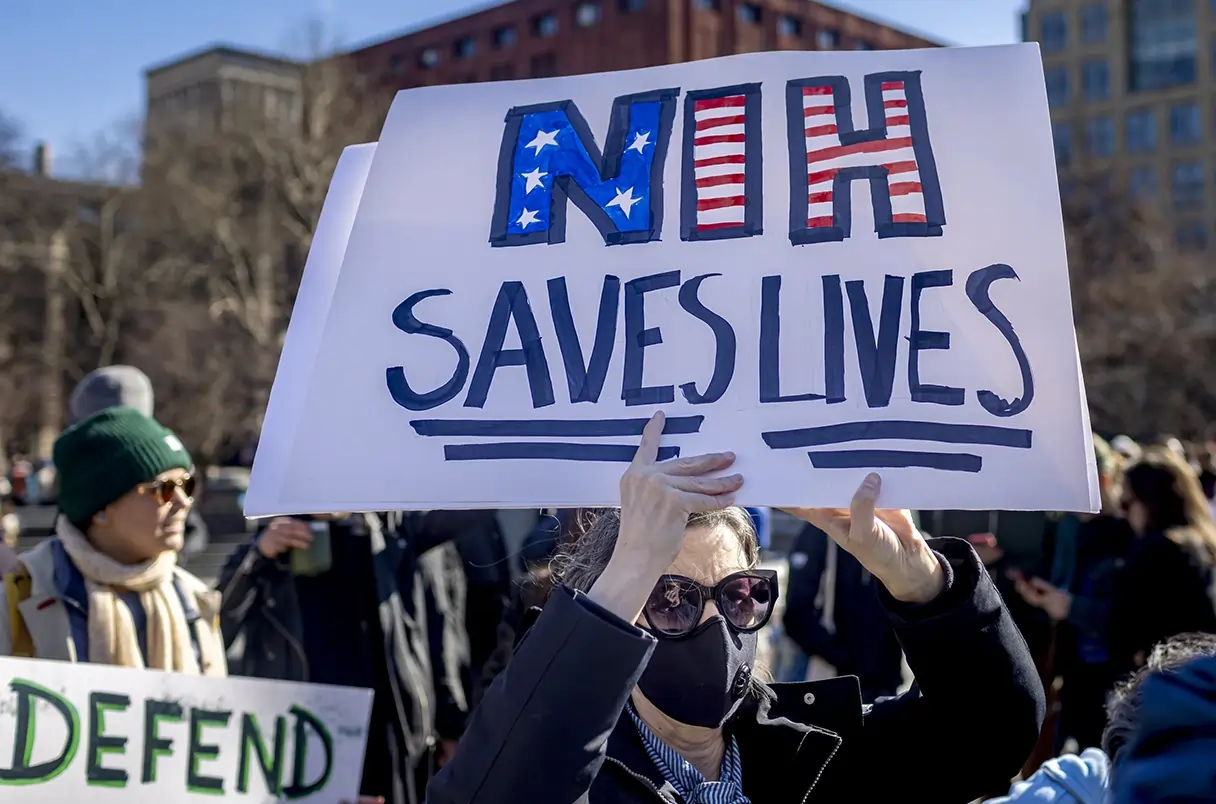
Boston — A federal appeals court has ruled against the Trump administration's plan to cut the National Institutes of Health's (NIH) research overhead costs by a large amount. This is a big blow to efforts to cut federal research funding. On Monday, the U.S. Court of Appeals for the First Circuit said that NIH's decision to limit indirect cost rates to 15% was against federal rules.
The Case's Background
The disagreement is about NIH's effort to limit how much it pays research institutions for indirect costs, which are also called overhead costs. These costs include the upkeep of buildings, utilities, equipment, and administrative help needed to do scientific research. In the past, research institutions and the government have agreed on rates that make sure these costs are fairly paid.
The NIH told new and existing grants in 2025 that they could only get back 15% of their indirect costs. Critics said this would greatly reduce research funding. More than 20 states, as well as well-known academic groups like the Association of American Medical Colleges and the Association of American Universities, opposed the NIH's action, saying it broke federal law.
Court Decisions and the Reasons Behind Them
Last year, a lower court agreed with the plaintiffs and said that the NIH guidance was against the law. This stopped the agency from putting the cap in place. The court made it clear that Congress had made sure that the negotiated indirect cost rates were safe, so NIH's attempt to replace them with a flat, uniform rate was illegal.
The First Circuit upheld this decision on Monday. Judge Kermit Lipez wrote that Congress "went to great lengths" to stop NIH from replacing negotiated rates. The court also pointed to an older congressional appropriations rider that gave the agency several reasons to cancel its actions.
Judge Lipez said that NIH's guidance had a major flaw: it didn't let people redo their indirect costs on an individual basis, which is required by federal law. He said, "That argument shows a serious flaw in the Supplemental Guidance."
Legal Arguments and Technicalities
The government said that the case should have been filed in the U.S. Court of Federal Claims because it involved federal contracts and money damages. They used the Tucker Act as evidence. The appeals court, on the other hand, said that the lawsuit was properly brought in the district court and that the NIH guidance went beyond what the agency was allowed to do.
Judges Julie Rikelman and Jeffrey Howard agreed with the opinion, which made the court's position against NIH's attempts to set arbitrary cost limits even stronger.
What this means for research funding
This choice keeps the indirect cost rates that schools and other institutions need to do important research. States, universities, and medical centers that said the caps would put current and future scientific work at risk see the decision as a win.
The legal battles show that the federal government is still trying to control spending while the scientific community needs stable research funding. Some people say that trying to keep costs low could hurt innovation, slow down medical breakthroughs, and hurt the U.S.'s standing as a leader in science and technology.
Cases and References in the Law
The cases in question are:
- Commonwealth of Massachusetts v. NIH, No. 25-1343
- Association of American Medical Colleges v. NIH, No. 25-1344
- Association of American Universities v. Department of Health and Human Services, No. 25-1345
These decisions show how important it is to follow federal rules and congressional directives about funding for research.