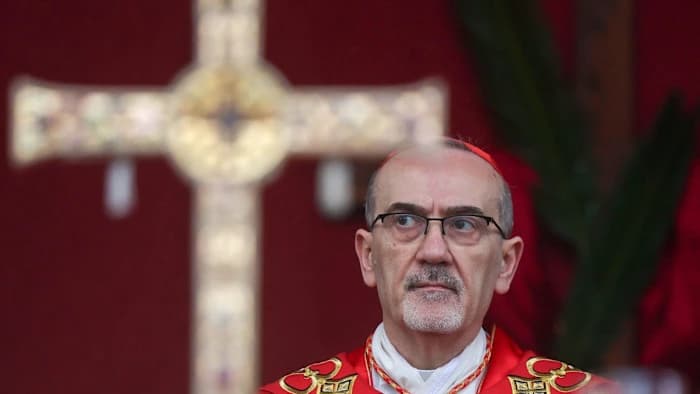
World leaders have expressed alarm after Israeli police barred Cardinal Pierbattista Pizzaballa, the Latin patriarch of Jerusalem, from visiting the Church of the Holy Sepulchre on Sunday.
Pizzaballa attempted to accompany the Rev. Francesco Ielpo to the Palm Sunday Mass at a church in Jerusalem's Old City. The Latin Patriarchate of Jerusalem stated that the two were halted en route and forced to turn back, marking "the first time in centuries" that Palm Sunday Mass could not be held at the church.
The church is Christianity's holiest place, built where many believe Jesus was crucified. According to Israeli authorities, all holy sites in the Old City were closed to worshippers when the war with Iran began in February.
Authorities cited security concerns, claiming that the Old City created challenges for emergency responders during a mass casualty catastrophe. The Latin Patriarchate claimed that the two men were "proceeding privately and without any characteristics of a procession or ceremonial act."
Why This News Matters:
This incident isn't just about a single denied visit; it highlights a particularly delicate situation: access to sacred sites during wartime. When a prominent religious leader is barred from the Church of the Holy Sepulchre on a day of profound importance to Christians, it casts a shadow over religious liberty and the respect due to the customs cherished by millions around the world.
Global Backlash and Diplomatic Reactions
US Ambassador to Israel Mike Huckabee offered his perspective, declaring, "It's difficult to understand or justify preventing the Patriarch from attending the Church on Palm Sunday for a private ceremony."
Giorgia Meloni, the Italian Prime Minister, expressed "solidarity" with Pizzaballa and others who were banned from attending Palm Sunday Mass. France's President Emmanuel Macron slammed the move, describing it as part of a "worrying series of violations" against sacred places.
Spain summoned Israel's senior envoy in protest, with Foreign Minister Jose Manuel Albares declaring, "This cannot happen again; Catholic worship must be celebrated normally."
The German envoy described the episode as "painful to all Christians," while European Parliament officials termed it a "grave, unprecedented, and unacceptable violation of religious freedom."
Italy's Foreign Minister, Antonio Tajani, said he will summon Israel's envoy to seek clarification.
Israel’s Response and Policy Reversal
Israeli Prime Minister Benjamin Netanyahu's office stated that police intervened "out of special concern for his safety," emphasizing that there was "no malicious intent whatsoever."
Following significant criticism, Netanyahu promised "full and immediate access," claiming officials would allow the Patriarch to hold services. Israeli authorities later agreed to a "limited prayer framework" for the church.
Netanyahu went on: "As soon as I learned about the incident with Cardinal Pizzaballa, I instructed the authorities to enable the Patriarch to hold services as he wishes."
Police insisted that the limits were essential due to the war, citing missile fragments that had previously landed near the church and other holy places.
Religious Restrictions Amid Ongoing War
The ceremonial Palm Sunday procession, which often draws thousands of people, was canceled owing to conflict-related limitations on big gatherings.
This year, Christians, Muslims, and Jews have been unable to celebrate Easter, Ramadan, or Passover as normal due to police restrictions. During Ramadan, Jerusalem's Al-Aqsa Mosque was mostly empty, and few people visited the Western Wall before Passover.
Palm Sunday signals the start of Holy Week, a pivotal event in the Christian calendar. The Latin Patriarchate stated that the occurrence establishes "a grave precedent" and disregards the sensibilities of billions of people worldwide.
In response to the public outcry, authorities unveiled a plan. Church leaders would be permitted to hold services for the remainder of Easter week, despite the ongoing restrictions tied to the conflict.
What to Watch Next:
The next question is if this was a one-time thing or part of a bigger pattern. Israel's decision to let limited access again may help things calm down, but world leaders will be watching closely to see if the restrictions stay in place during important religious events. In the next few days, it will be important to see how the government balances security with access to religious sites, especially when there is conflict.