The Trump administration blamed overloaded air traffic control systems for a nationwide ground stop that disrupted thousands of flights across the United States on Friday, describing the incident as the result of new technology placing additional pressure on aging infrastructure. Federal officials said intermittent communications and radar failures prompted the Federal Aviation Administration (FAA) to halt most departing flights for approximately five hours.
The restriction was lifted Friday evening, allowing a limited number of domestic flights to resume. However, airlines faced a lengthy recovery process because aircraft and flight crews had been displaced across the country. The disruption affected thousands of flights and potentially more than a million travelers, making it the longest nationwide ground stop in 25 years.
Homeland Security Secretary Markwayne Mullin said no passengers or aircraft were placed in danger during the incident, noting that more than 3,000 flights had been landed safely. Transportation Secretary Sean Duffy, however, warned that officials could not guarantee the problem would not happen again.
Officials Blame Aging Equipment and Technology Overload
Mullin said the FAA had been installing new equipment and technology when the upgrades overwhelmed older components of the air traffic control system. He said there was no apparent evidence of a cyberattack or other deliberate interference, although investigators were still working to establish the precise cause.
When asked whether officials could rule out a cyberattack or an incident involving rogue artificial intelligence, Mullin said investigators had found no identifiable signs of an attack. He described the problem as appearing to be mechanically driven.
Duffy also rejected suggestions that the outage was connected to the FAA's new AI-powered system, which is being introduced to help predict potential problems in the airspace. He said that system was not connected to the equipment that failed Friday.
According to Duffy, the outage involved older legacy equipment, while the newer technology already deployed by the FAA continued operating. He said the new equipment itself had not failed.
Thousands of Flights Diverted Across the Country
The ground stop affected a substantial portion of U.S. air travel. At least 827 flights were diverted, according to aviation analytics company Cirium. By 7:05 p.m. Eastern time, 670 flights had returned to their original departure airports, while another 157 had been redirected to different airports.
Many diverted aircraft were sent to major airports, including Washington Dulles International Airport, Los Angeles International Airport and Nashville International Airport. More than 11,000 flights carrying over 1.5 million passengers had been scheduled to depart U.S. airports after 4 p.m. Eastern time.
Duffy said more than 3,500 aircraft were in the sky when the ground stoppage began. Although officials said the planes were safely managed, the disruption created significant logistical challenges for airlines and airport operations.
The FAA's decision marked the first nationwide ground stop since January 2023, when a malfunction in a computer system responsible for sending notices to pilots disrupted air travel. It was also the second nationwide stoppage since the aftermath of the September 11, 2001, terrorist attacks.
Transportation Secretary Calls for More Funding
Duffy criticized Congress for not approving additional funding to modernize the country's air traffic control infrastructure. He argued that delaying investment in the system increased operational risks and urged lawmakers to provide the resources needed to complete the modernization effort.
“By doing nothing, you inject way more risk into the system,” Duffy said.
He expected flights to return to normal operations ahead of the Thanksgiving travel rush, saying airlines should be able to handle increased demand by the following weekend. However, he also acknowledged that additional outages could occur.
Duffy said officials had been able to review the failure, reboot the system and restore operations, but cautioned that similar disruptions might happen again. He said the government had not anticipated an outage of this scale.
The FAA has already replaced thousands of aging copper wires with fiber-optic lines and upgraded hundreds of radio systems as part of a modernization program that began last year. Congress previously approved $12.5 billion for the work, while Duffy and the White House are seeking an additional $30 billion to complete the overhaul.
Travelers Face Delays and Uncertainty at Airports
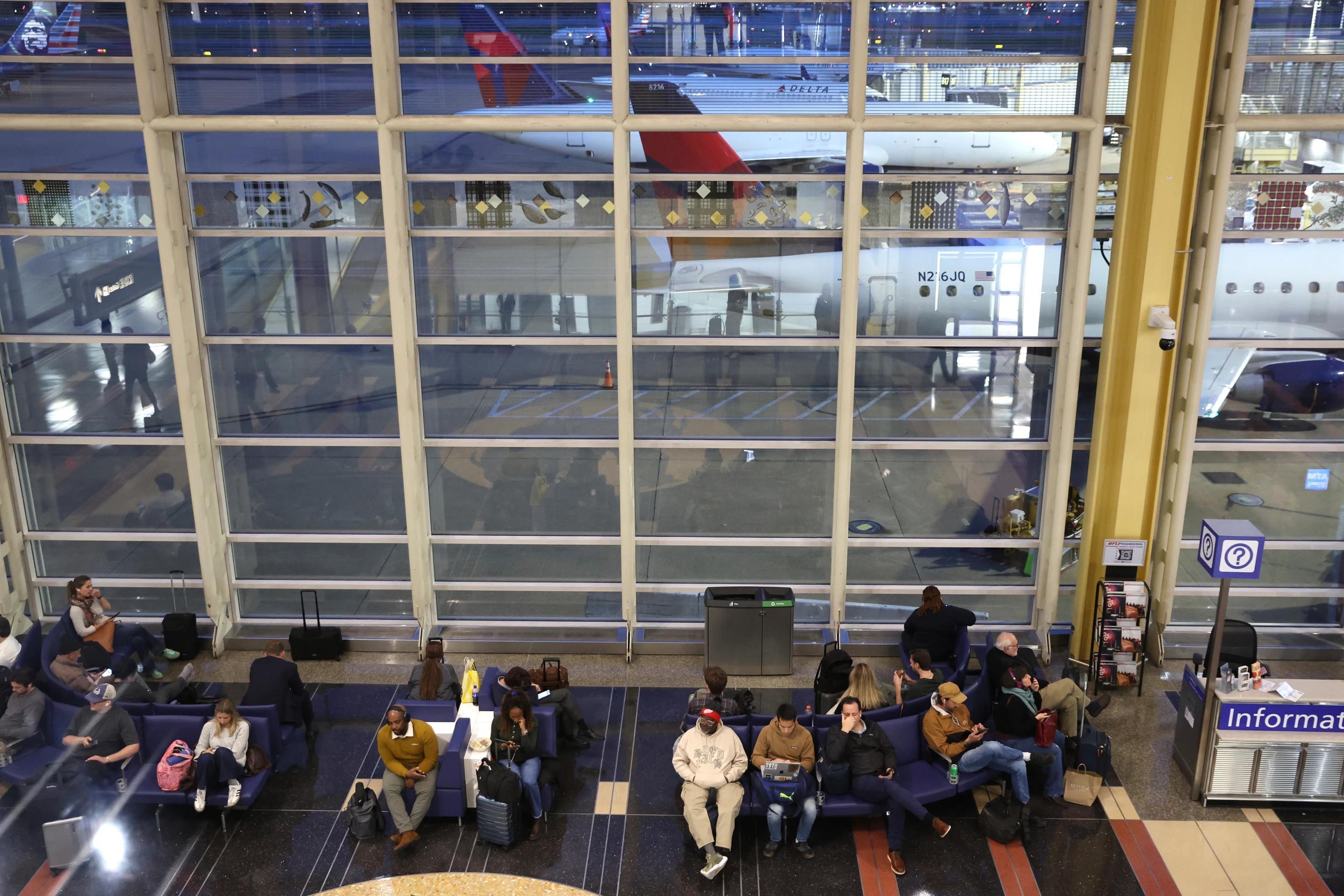
Passengers across the country experienced delays, missed connections and uncertainty as the ground stop affected airport operations. At Chicago O'Hare International Airport, travelers discovered the disruption through departure screens showing widespread delays. Some considered staying overnight in Chicago, while others explored alternative ways to reach their destinations.
Amber McQuilkin, a 27-year-old software engineer from Seattle, worried that the disruption could prevent her from traveling to New York with friends to attend the League of Legends world finals. She said passengers were receiving little information and briefly considered driving instead, before deciding that the alternative would be difficult.
At Los Angeles International Airport, Ruth Coles remained aboard her aircraft for hours after it landed from Newark. Even after the nationwide ground stop was lifted, passengers were told they were waiting for a gate to become available.
Coles said the pilot repeatedly announced that the aircraft was next in line for a gate, although several hours had passed without the plane being allowed to disembark.
Sports Teams and Cargo Operations Also Disrupted
The disruption extended beyond commercial passengers, leaving NBA, NHL and college sports teams stranded as they attempted to travel to scheduled events. NFL teams also faced uncertainty about whether they would be able to reach their destinations for weekend games.
Duffy said NCAA teams would receive priority ahead of Saturday's football games. He encouraged teams to contact the FAA to coordinate departure schedules and ensure they could reach their venues in time for kickoff.
Cargo operators were also affected by the ground stop. FedEx, the world's largest cargo airline, said it was prepared to activate contingency plans to limit potential disruptions to its operations.
The scale of the disruption raised concerns for the wider supply chain. According to Airlines for America, the U.S. airline industry transports approximately 61,000 tons, or 55,340 metric tonnes, of goods each day to and from more than 220 countries. The shipments include everything from letters to commercial packages.
Aging Air Traffic Control Systems Have Caused Previous Disruptions
Friday's incident followed other problems involving aging aviation infrastructure. In September, a regional communications outage disrupted hundreds of flights across the northeastern United States after a construction crew accidentally cut a fiber-optic line. Equipment failures were also blamed for brief radar outages that affected operations at Newark Airport last year.
Aviation safety expert Steve Arroyo, a former United Airlines pilot, said the nationwide scale of Friday's disruption made it particularly serious. He explained that air traffic controllers must be able to communicate reliably with pilots to manage aircraft safely.
When that communication cannot be maintained, whether because of deteriorating wires or other technical problems, stopping aircraft on the ground becomes necessary to avoid placing planes in situations where controllers may be unable to communicate with them.
Arroyo also distinguished Friday's incident from the nationwide ground stop following the September 11 attacks. He said Friday's response did not involve instructions for aircraft already in the air to land immediately, and pilots were likely still able to communicate with ground controllers at airports.
FAA Modernization Remains a Major Challenge
The ground stop has renewed questions about the reliability of the country's air traffic control infrastructure as the FAA attempts to replace aging equipment with modern technology. Friday's outage demonstrated the risks of operating older systems while introducing new equipment, particularly when critical communication and radar functions are affected.
Although flights were permitted to resume, the immediate challenge for airlines was restoring aircraft schedules, repositioning crews and managing passenger backlogs. Officials expressed confidence that operations would stabilize ahead of Thanksgiving, but Duffy's warning about possible future outages left uncertainty over the system's reliability during one of the busiest travel periods of the year.