

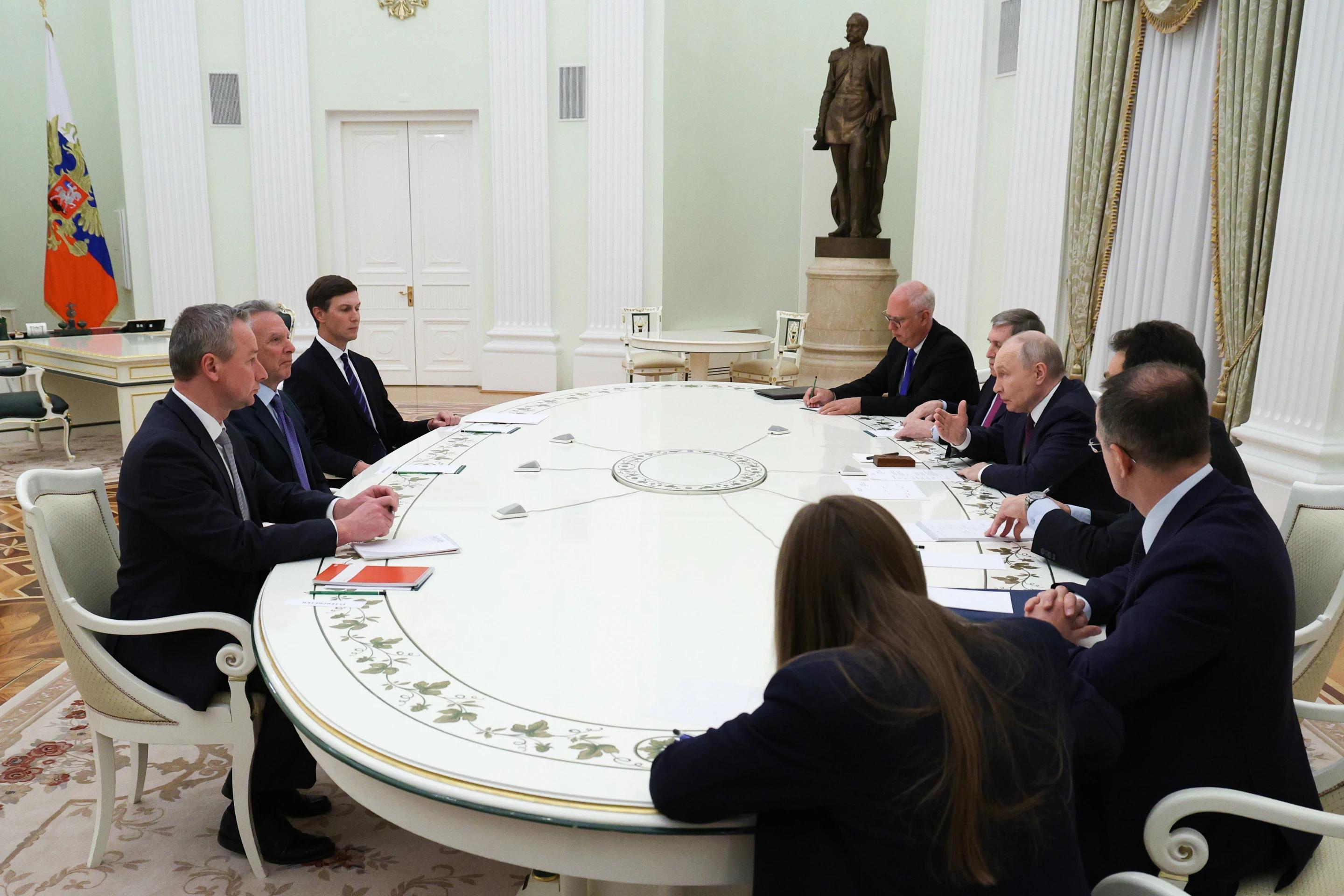
U.S. envoys met Russian President Vladimir Putin in Moscow on Thursday before traveling to Ireland to hold discussions with Ukrainian President Volodymyr Zelenskyy, as Washington attempted to revive diplomatic efforts to end Russia's war in Ukraine. The meetings followed negotiations between Russian and Ukrainian delegations in Abu Dhabi earlier this week, marking the first direct discussions between the two sides in nine months.
The American delegation included Steve Witkoff and Jared Kushner, President Donald Trump's son-in-law. The two envoys had helped arrange the Abu Dhabi negotiations, which produced no major breakthrough on a broader peace settlement. However, the participants agreed to exchange a significant number of prisoners, with the exact figure yet to be announced, and discussed plans for another round of negotiations.
Kushner and Witkoff met Putin at the Kremlin for approximately two hours before traveling to Dublin. They subsequently met Zelenskyy for more than an hour as the conflict approaches its fifth year.
Europe Seeks a Direct Role in Peace Negotiations
One of the central issues surrounding the latest diplomatic discussions is whether European representatives will participate directly in future negotiations. Kushner said the meeting with Putin was partly intended to obtain the Russian leader's approval for European involvement in discussions about the continent's broader security arrangements.
Several European security advisers participated in discussions on the sidelines of the Abu Dhabi meeting but were excluded from the main negotiations involving Russia, Ukraine and the United States. Witkoff told reporters before leaving Moscow that another round of talks had been agreed upon and indicated that European representatives would participate.
Zelenskyy also emphasized that Europe must have a formal place at the negotiating table rather than participate through separate discussions. Speaking in Dublin, he said European representatives would be part of the negotiation team and would have a direct voice in the process.
Washington and Kyiv want European countries to appoint a single representative to negotiate with Moscow. Russia, however, has opposed direct European participation, arguing that European governments are supporting Ukraine's military effort through financial assistance and weapons supplies.
Kremlin spokesman Dmitry Peskov said European countries would need to identify a representative before joining the negotiations. He also criticized divisions among European governments, suggesting that anyone attempting to establish direct contact with Russia could face political isolation.
European leaders remain concerned about Russia's intentions and the possibility that discussions over postwar security could give Moscow concessions regarding NATO's military presence in the region. Putin has repeatedly described NATO's eastward expansion as a major security threat and demanded that the alliance withdraw forces from areas near Russia's borders.
Putin Repeats Russia's Security Demands
Putin's aide Yuri Ushakov described Thursday's discussions as substantive, constructive, frank and useful. He said the Russian president reminded the American envoys of Moscow's security proposals from 2021, which called for NATO to reverse its military deployments in Central and Eastern Europe before Russia launched its full-scale invasion of Ukraine.
According to Ushakov, Russia intends to update those proposals with additional considerations. The comments reinforced concerns among European officials that negotiations could involve concessions affecting NATO's broader military strategy in exchange for an agreement to end the war.
Putin also reiterated Moscow's opposition to the deployment of European troops in Ukraine following a potential ceasefire. He described such a deployment as absolutely unacceptable, warning that Russia would consider foreign troops a security threat and a legitimate target. He indicated that their presence could lead to an immediate resumption of fighting.
The Russian president also maintained Moscow's position regarding the territories it claims in Ukraine. He said Russia considers the areas of four Ukrainian regions annexed by Moscow in 2022 to be part of its border, despite Russian forces never having gained full control over those territories.
Zelenskyy Meets European Leaders as Fighting Continues
Zelenskyy traveled to Dublin for a meeting involving more than 40 European countries, with NATO Secretary-General Mark Rutte also participating. The gathering comes as European governments seek a greater role in shaping any future peace agreement and determining the security arrangements needed to prevent another Russian attack.
Rutte said the United States, Europe and Ukraine were largely aligned on the nature of potential security guarantees following discussions in Paris in January. However, he emphasized that a peace agreement or at least a ceasefire remained necessary before those guarantees could be put into practice.
Diplomatic efforts are continuing while fighting persists along a front line stretching approximately 1,200 kilometers, or 750 miles. Ukrainian resistance has slowed Russia's larger military, while Russian drone and missile attacks on energy infrastructure have disrupted electricity, heating and water supplies in Ukrainian cities.
Kyiv has described the attacks on essential infrastructure as a weaponization of winter, warning that repeated damage to energy facilities is worsening conditions for civilians as colder weather approaches.
Russia's Defense Ministry said its air defenses intercepted 71 Ukrainian drones overnight. The ministry also claimed that Russian forces struck a drone-manufacturing plant in Kyiv and three additional facilities producing missile fuel and drone components in the surrounding area.
Ukraine's air force reported that Russia launched missiles and 123 drones overnight, including 73 jet-powered drones. It said impacts were recorded at 17 locations across the country.
Zelenskyy Reports Renewed Starlink and Starshield Disruptions
Another concern for Ukraine emerged as Zelenskyy reported renewed disruptions affecting the U.S. Starshield satellite communications system. Starshield is SpaceX's military-oriented version of its Starlink satellite internet service, which Ukrainian forces use for communications and military operations against Russian attacks.
In a social media statement Thursday, Zelenskyy said Ukrainian military units had experienced significant disruptions, including speed restrictions that limited the operation of Ukrainian drones to approximately 161 kilometers per hour, or 100 miles per hour. He said a military investigation found that the restrictions were not the result of random technical errors.
Ukraine relies on Starlink and Starshield connectivity to intercept Russian drones and coordinate its own drone operations. Similar restrictions imposed the previous month had significantly disrupted Ukrainian military activities and raised concerns in Kyiv about the reliability of American support.
SpaceX CEO Elon Musk previously acknowledged that his company had throttled Starlink internet service in Ukraine for approximately a week. Musk said the system could not be used for offensive strikes against Russia.
Zelenskyy said the latest speed restrictions also affect operations in Russian-occupied areas of Ukraine. Kyiv is seeking clarification from U.S. officials about the cause and scope of the disruptions.
Russian Colonel Reportedly Killed in St. Petersburg Car Bombing
Separately, a Russian serviceman was killed early Thursday when his vehicle exploded in St. Petersburg, according to the country's Investigative Committee, the main agency responsible for criminal investigations. Authorities did not identify the victim or disclose who they believed was responsible for the explosion.
The Russian news outlet Fontanka reported that the victim was a colonel and that a bomb inside his vehicle detonated as he began driving. The reported attack adds to a series of bombings and other incidents in which senior Russian military officers have been killed.
Moscow has blamed Ukraine for several attacks targeting Russian military personnel and facilities, while Kyiv has claimed responsibility for some operations conducted on Russian territory.
Diplomatic Progress Remains Uncertain
The latest meetings in Moscow and Dublin demonstrate Washington's efforts to bring Russia, Ukraine and European governments closer to a negotiated settlement. However, disagreements over territorial claims, NATO's military presence and the role of European forces after a ceasefire continue to complicate the process.
With fighting ongoing, infrastructure attacks continuing and questions emerging over Ukraine's access to critical satellite communications, the prospects for a lasting agreement remain uncertain. The planned next round of negotiations is expected to test whether the parties can move beyond preliminary discussions toward a broader framework for ending the conflict.